Chapter 5: Overview of Geospatial Data Structures
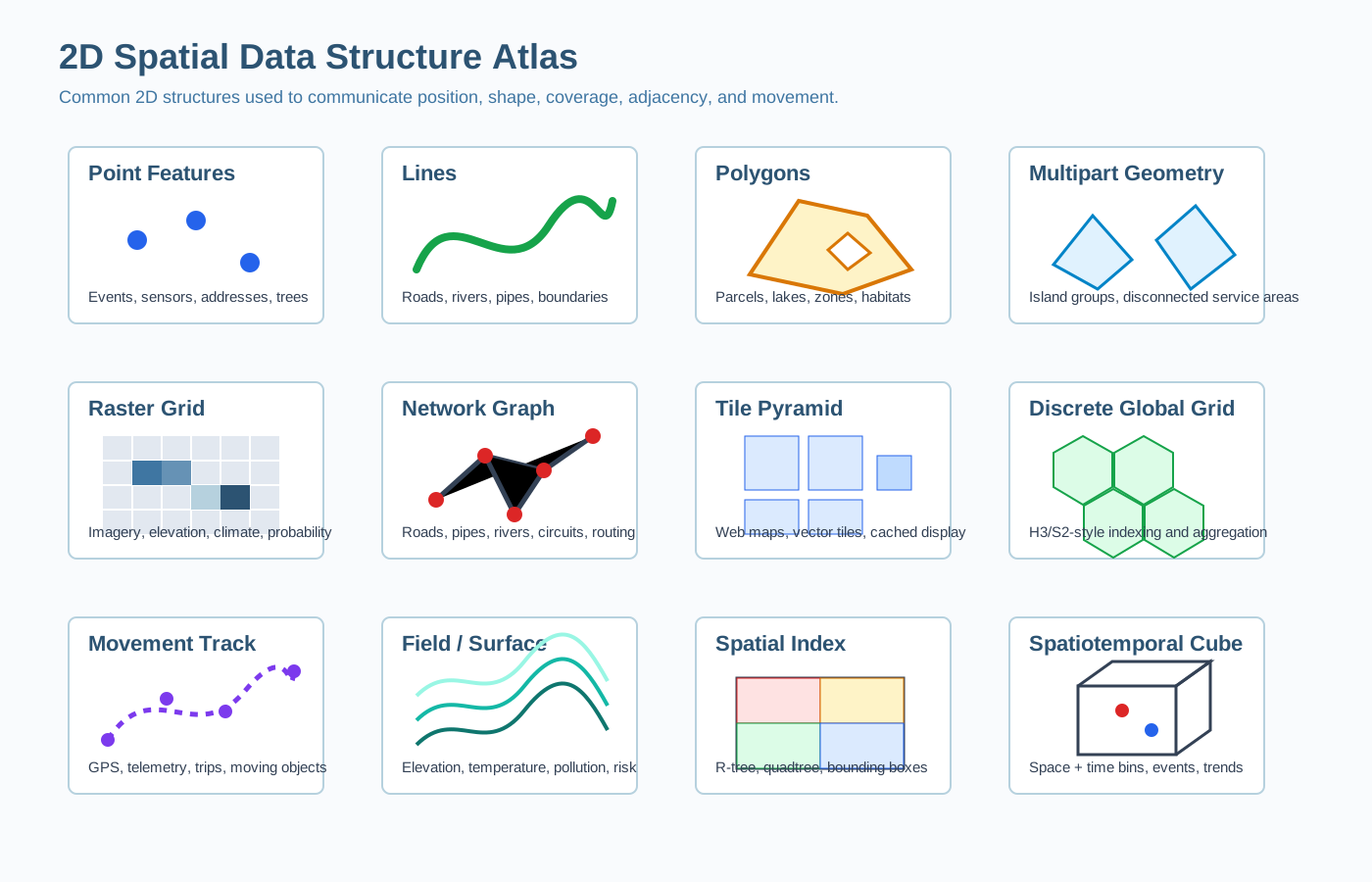
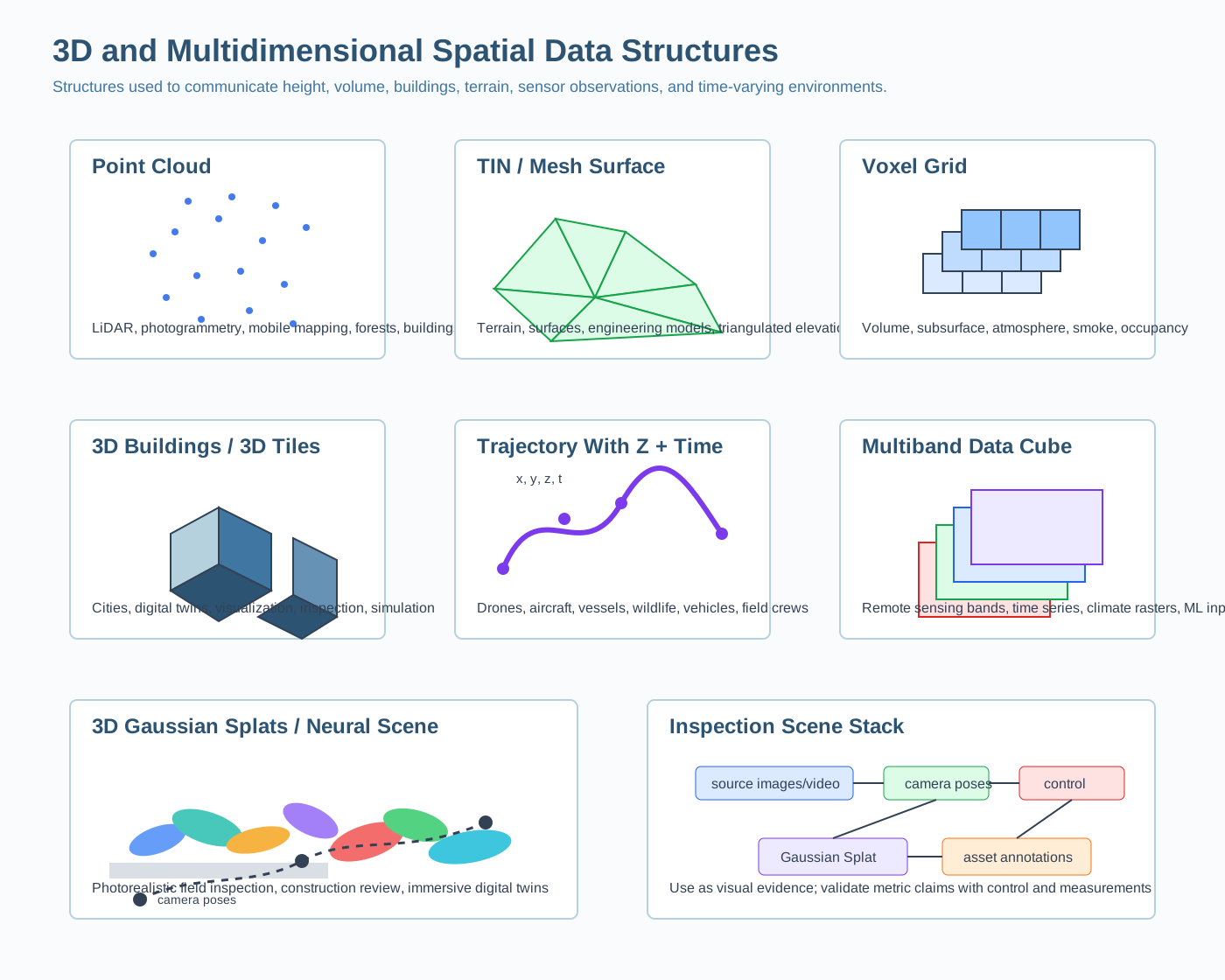
Geospatial data structures encode spatial meaning for computation. The choice between point, line, polygon, raster, mesh, graph, tile, or index determines what questions are easy, expensive, approximate, or impossible.
Companion visual reference: Spatial Data Structure Visual Atlas
Learning Goals
- Explain vector, raster, graph, point cloud, tile, and 3D data structures.
- Choose data structures based on analytical and operational needs.
- Understand spatial indexes such as R-trees, quadtrees, geohashes, H3, and S2.
- Recognize how file formats encode geometry, CRS, attributes, and metadata.
Theory
Vector data represents discrete features. Raster data represents values over a grid. Graphs represent connectivity. Point clouds represent dense sampled 3D observations. Meshes and 3D tiles represent surfaces and built environments. Gaussian Splatting represents a scene as many translucent, oriented 3D ellipsoids optimized from overlapping images or video. Spatial indexes organize space so queries do not scan every feature.
The key engineering principle is fitness for use. A building footprint belongs naturally as a polygon. Elevation often belongs as a raster or triangulated surface. A road network belongs as a graph. A global aggregation grid may belong in H3 or S2 cells.
For field inspection, a Gaussian Splat scene can be an excellent operational record because crews and engineers can revisit a photorealistic site capture from many viewpoints. It should not be treated as a legal boundary, survey control network, or engineering-grade CAD model unless it is explicitly registered, validated, and tied to authoritative measurements.
Research and Standards Foundations
Most production vector systems still inherit ideas from the OGC Simple Features model: points, curves/lines, polygons, multipart geometries, geometry collections, and spatial predicates. Modern analytics systems extend that lineage into columnar and cloud-native formats such as GeoParquet, while web systems often transform source features into tiles or generalized geometries for display.
Global grid systems such as H3 and S2 are not replacements for exact geometry. They are indexing and aggregation frameworks. H3 partitions the world into hierarchical hexagonal cells and is useful for scalable joins, aggregation, visualization, and machine learning features. The tradeoff is that cell membership is an approximation of continuous geometry, so exact boundary decisions still require geometry predicates when legal, safety, or scientific precision matters.
Math
Data structures depend on coordinate tuples, topology, grid resolution, sampling theory, graph adjacency, tree partitioning, and hashing. Raster resolution controls cell size and therefore both storage cost and analytical precision. Index resolution controls lookup speed and approximation error.
Key computation patterns:
2D point: p = [x, y]
3D point: p = [x, y, z]
spatiotemporal observation: o = [x, y, z, t, attributes...]

raster cell lookup:
value = raster[row, col]

space-time cube:
cube[cell_id, time_bin] = aggregate(events in cell_id during time_bin)

3D Gaussian primitive:
g_i = {mu_i, Sigma_i, alpha_i, color_i}
See also: Math and Algorithms Reference
Tools of the Trade
- Formats: GeoJSON, WKT, WKB, GeoPackage, Shapefile, KML, GML, GeoParquet, COG, Zarr, NetCDF, LAS/LAZ, 3D Tiles, Gaussian Splat scenes and viewer packages.
- Indexes: R-tree, GiST, SP-GiST, quadtree, geohash, H3, S2.
- Libraries: GDAL/OGR, GEOS, PROJ, PDAL, laspy, GeoPandas, Shapely, rasterio.
Examples of Real-World Solutions
- A delivery app stores stops as points, roads as graphs, service areas as polygons, and traffic as time-dependent edge weights.
- A climate app stores temperature as raster time series.
- A smart city digital twin stores buildings as 3D tiles and sensors as moving events.
- A global analytics platform aggregates events into H3 cells to compare regions consistently.
- A bridge inspection workflow stores baseline imagery, camera poses, a Gaussian Splat scene, asset IDs, and defect observations so engineers can visually compare conditions across visits.
Working Practice Examples
- Model the same park as a point, polygon, raster mask, and label. Explain what each version can and cannot answer.
- Build a small GeoJSON feature collection and convert it to GeoParquet.
- Aggregate event points into H3 or S2 cells and map the counts.
- Compare bounding-box filtering with an exact geometry predicate.
- Capture or use a sample multi-view image set, inspect the derived camera poses, and document which parts of a Gaussian Splat scene are visual evidence versus measured geometry.
Common Failure Modes
- Choosing a format because it is familiar rather than appropriate.
- Treating raster pixels as exact boundaries.
- Storing large geometry in APIs without simplification or tiling.
- Forgetting that index cells are approximations.
- Losing CRS and metadata during conversion.
- Treating photorealistic Gaussian Splat output as proof of metric accuracy without calibration, control, or validation.
Works Cited
"GeoParquet Specification." GeoParquet, https://geoparquet.org/. Accessed 9 May 2026.
"H3: Hexagonal Hierarchical Geospatial Indexing System." H3Geo, https://h3geo.org/. Accessed 9 May 2026.
"OGC Simple Feature Access." Open Geospatial Consortium, https://www.ogc.org/standards/sfa/. Accessed 9 May 2026.
"3D Gaussian Splatting for Real-Time Radiance Field Rendering." GraphDeco Inria, https://repo-sam.inria.fr/fungraph/3d-gaussian-splatting/. Accessed 9 May 2026.
Kerbl, Bernhard, et al. "3D Gaussian Splatting for Real-Time Radiance Field Rendering." ACM Transactions on Graphics, vol. 42, no. 4, 2023, article 139. https://doi.org/10.1145/3592433.
Mildenhall, Ben, et al. "NeRF: Representing Scenes as Neural Radiance Fields for View Synthesis." Computer Vision -- ECCV 2020, Springer, 2020, pp. 405-421. arXiv, https://arxiv.org/abs/2003.08934.
"S2 Geometry." S2 Geometry, https://s2geometry.io/. Accessed 9 May 2026.
Samet, Hanan. Foundations of Multidimensional and Metric Data Structures. Morgan Kaufmann, 2006.
