Spatial Data Structure Visual Atlas
This visual atlas gives readers a quick way to understand what different spatial data structures communicate. A non-spatial software engineer can think of these as domain-specific data models: each structure makes some questions easy, some expensive, and some inappropriate.
2D Spatial Structures
3D and Multidimensional Structures
How to Read These Structures
Points
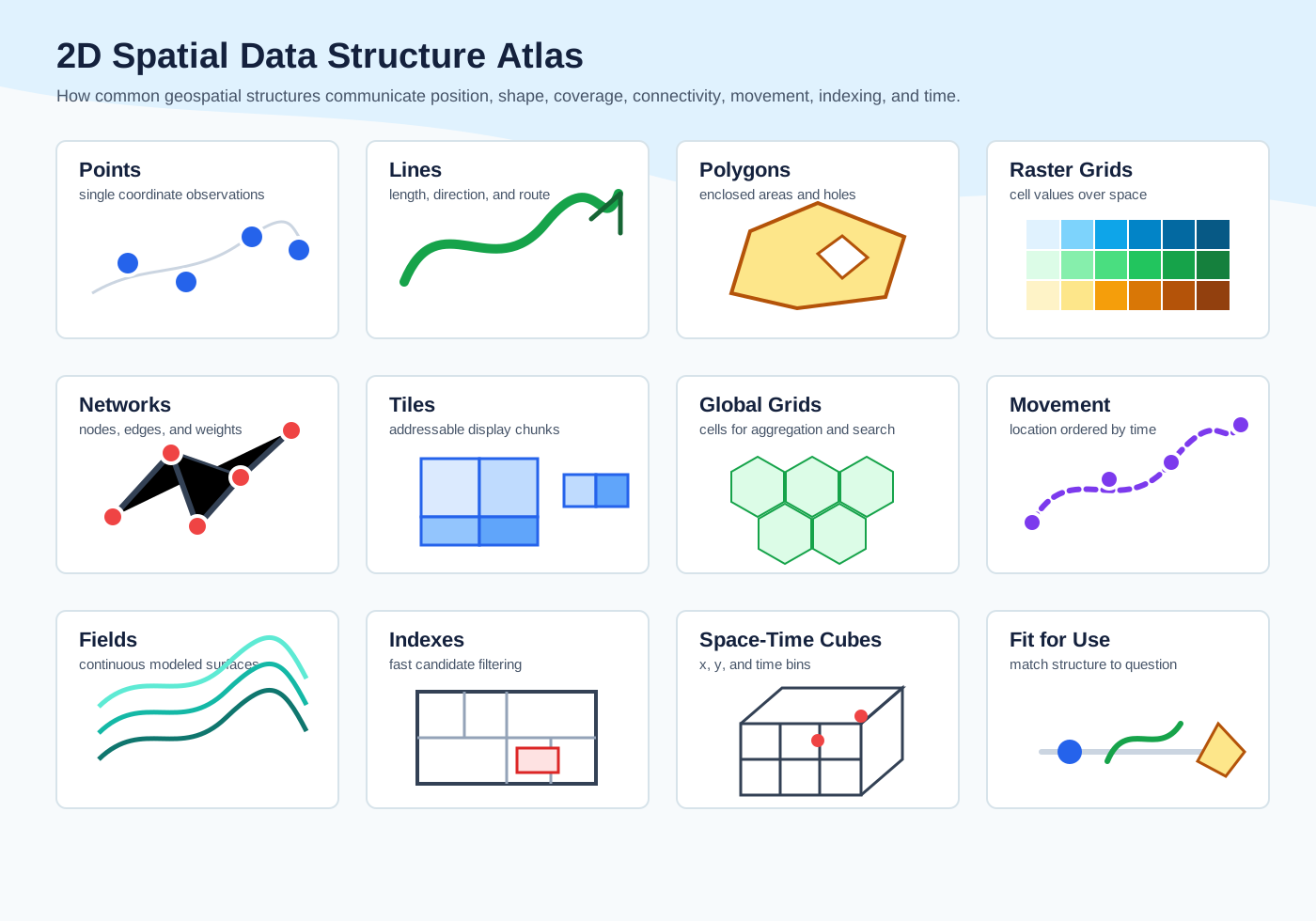
Points communicate location without area or length. They are best for events, observations, addresses, sensors, trees, hydrants, stops, and other things that can be treated as a single coordinate at the working scale.
Lines
Lines communicate length, direction, and connectivity, but not area. Roads, rivers, utility lines, boundaries, and tracks are often represented as lines. A line can be simple display geometry or part of a topological network.
Polygons
Polygons communicate enclosed area. Parcels, administrative boundaries, land cover, lakes, buildings, and zoning districts are common examples. Holes and multipart polygons matter: an island group, exclave, or service territory may be one feature with several disconnected pieces.
Rasters
Rasters communicate values over a grid. Imagery, elevation, temperature, land-cover probability, and risk surfaces often use raster structures. Resolution controls what can be seen and what gets averaged away.
Networks
Networks communicate connectivity and flow. Roads, pipes, electric circuits, rivers, and indoor routing systems need nodes, edges, weights, restrictions, and directionality.
Tiles
Tiles communicate spatial data at web scale. Raster tiles and vector tiles split space into addressable pieces so maps can render quickly. Tiling is usually a display and delivery strategy, not the source of truth.
Discrete Global Grids
Discrete global grids such as H3, S2, and geohashes communicate space as cells. They are useful for aggregation, indexing, search, and machine learning features. They approximate geography and should not replace exact geometry for legal or safety-critical boundary decisions.
Movement Tracks
Tracks communicate location through time. GPS traces, telemetry, trips, vessels, aircraft, wildlife, and field crews need timestamps, accuracy metadata, and sometimes map matching.
Fields and Surfaces
Fields communicate continuous or near-continuous values across space. Elevation, pollution, temperature, rainfall, and probability surfaces are examples. They may be represented as rasters, contours, TINs, or interpolated models.
Spatial Indexes
Spatial indexes communicate how a system accelerates search. R-trees, quadtrees, geohashes, H3, S2, and database indexes reduce the number of candidate geometries before exact spatial predicates run.
Spatiotemporal Cubes
Spatiotemporal cubes communicate values or events across both space and time. They are useful for trends, clustering, anomaly detection, and event aggregation.
Point Clouds
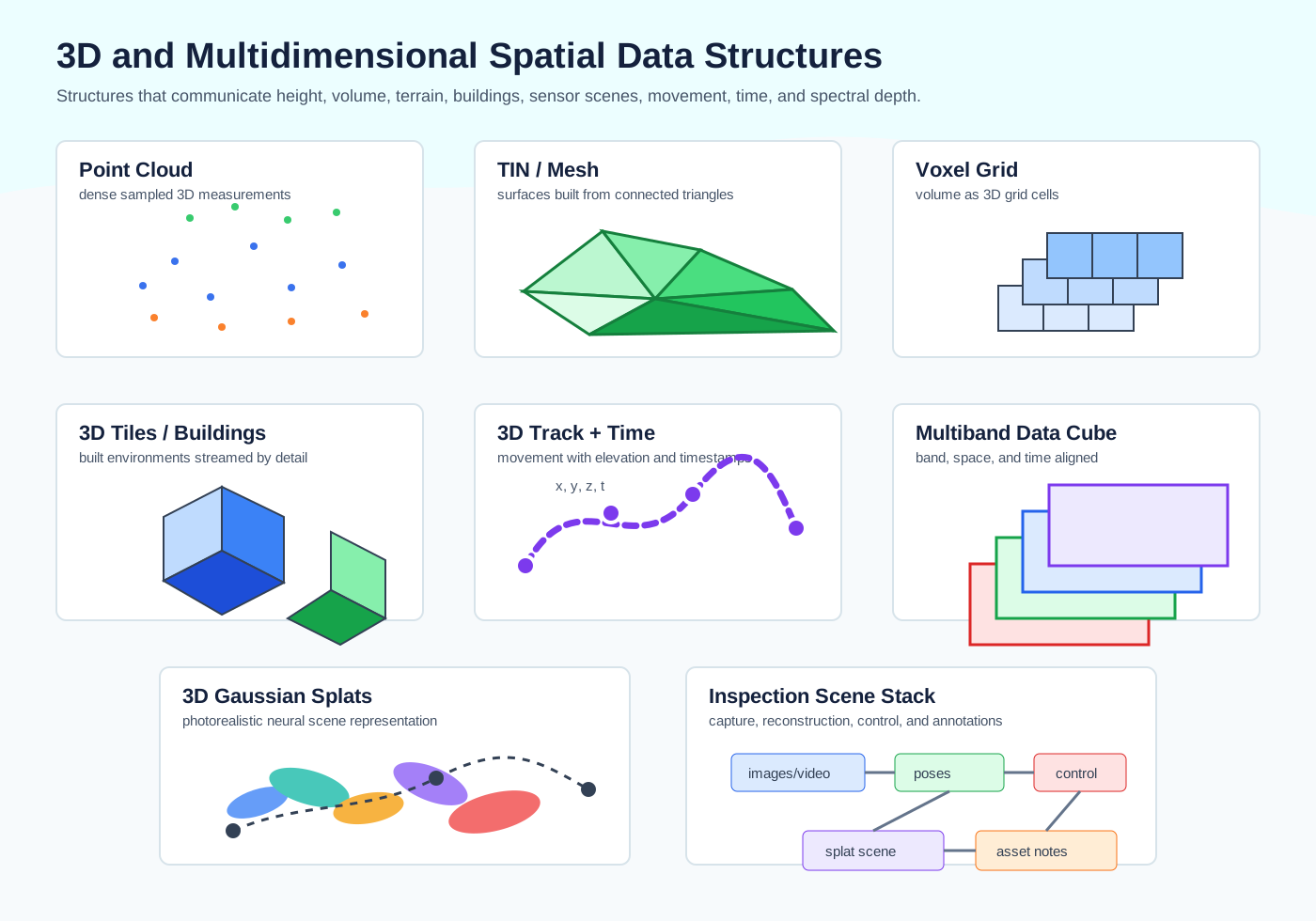
Point clouds communicate dense 3D measurements. LiDAR and photogrammetry point clouds can represent terrain, vegetation, buildings, power lines, roads, and indoor spaces.
TINs and Meshes
TINs and meshes communicate surfaces through connected triangles or polygons. They are common in terrain modeling, engineering, simulation, and 3D visualization.
Voxels
Voxels communicate volume through 3D grid cells. They are useful for subsurface models, atmosphere, smoke, ocean, occupancy, and 3D simulations.
3D Tiles and Buildings
3D tiles and building models communicate built environments at multiple levels of detail. They support digital twins, city visualization, inspection, simulation, and spatial computing.
3D Gaussian Splats and Neural Scene Representations
3D Gaussian Splatting communicates a scene as many translucent, oriented 3D ellipsoids learned from overlapping images or video. It is useful for photorealistic field inspection, construction progress review, utility asset documentation, disaster assessment, and immersive digital twins. Unlike a survey-grade mesh or CAD model, a splat scene is primarily a view-synthesis and visual evidence structure; engineers should store camera poses, capture paths, timestamps, ground control, CRS alignment, source imagery, processing parameters, and uncertainty notes beside the rendered scene.
Multiband Data Cubes
Multiband data cubes communicate many measurements for the same spatial grid. Remote sensing imagery, climate data, and machine learning inputs often use data cubes with band, time, and sometimes vertical dimensions.
Engineering Guidance
- Choose the structure that matches the question, not the one that is most familiar.
- Keep source data, derived data, and display data separate.
- Preserve CRS, resolution, timestamp, accuracy, lineage, and license metadata.
- Use exact geometry for legal, safety, or high-precision decisions.
- Use indexes, grids, and tiles to accelerate search and display, but document approximation.
- Test spatial behavior with known-answer examples.
